


For a cooperative, managing a loan does not end when money is disbursed. A member applies for financing, the cooperative checks eligibility, assesses the request, makes an approval decision, documents the terms, releases the funds, records repayments and monitors the loan until it is fully settled. If the member falls behind, the cooperative also needs a defined process for identifying the problem and responding to it.
That makes cooperative loan management more than a lending transaction. It is an operating process that connects financial policy, member records, approval authority, repayment tracking, portfolio monitoring and governance.
The International Cooperative Alliance’s Cooperative Identity, Values and Principles defines a cooperative as a jointly owned and democratically controlled enterprise, with democratic member control and member economic participation among its seven cooperative principles. For a cooperative, therefore, how loans are administered affects more than the balance sheet. It also affects how responsibly the organization manages resources belonging to its members.
Quick Answer: How Do Cooperatives Manage Loans?
Cooperatives typically manage loans through a controlled lifecycle:
Application → Eligibility → Assessment → Approval → Documentation → Disbursement → Repayment → Monitoring → Recovery → Closure
The exact requirements vary according to the cooperative’s bylaws, loan policy, governance structure, type of lending activity and applicable laws or regulations.
What should remain consistent is the ability to trace each loan from the original application through its current status and, eventually, its closure.
A well-managed cooperative should be able to answer a basic set of questions about any loan:
Who borrowed? How much was approved? What was actually disbursed? Who authorized it? What has been repaid? What remains outstanding? Is the account performing as expected? What action is required if it is not?
The Cooperative Loan Lifecycle at a Glance
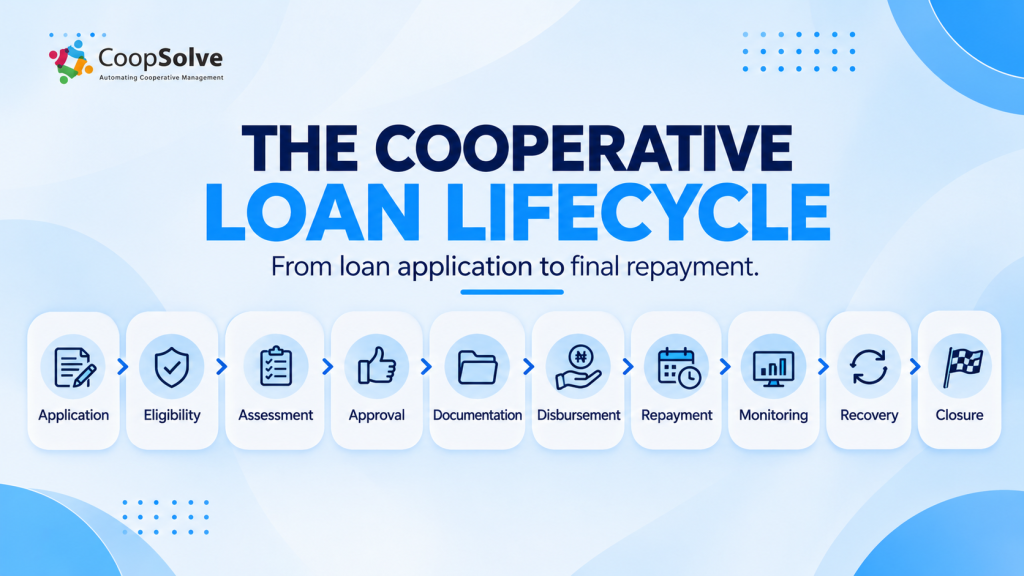
| Stage | What happens | Primary control |
| Application | A member requests a loan and provides the required information | Complete application |
| Eligibility | The cooperative determines whether the member qualifies under its policy | Eligibility verification |
| Assessment | The cooperative evaluates the request and repayment capacity | Consistent appraisal |
| Approval | An authorized officer or committee makes the lending decision | Delegated authority |
| Documentation | Approved terms and supporting records are captured | Complete loan record |
| Disbursement | Funds are released after approval conditions are satisfied | Controlled disbursement |
| Repayment | Payments are received and applied to the loan | Accurate transaction posting |
| Monitoring | Individual loans and the wider portfolio are reviewed | Arrears and portfolio reporting |
| Recovery | Overdue accounts are handled according to policy | Documented recovery process |
| Closure | The completed loan is reconciled and its status updated | Final balance confirmation |
The purpose of this lifecycle is not bureaucracy for its own sake. It is to make lending decisions traceable, repayment information reliable and problems visible early enough for management to respond.
Why Loan Administration Matters in a Cooperative
A cooperative loan has a different organizational context from an ordinary informal lending arrangement.
A cooperative is a member-owned organization. Its governing body, management and staff are responsible for applying policies that affect the organization’s resources and the members who use its services.
That is why loan administration sits at the intersection of finance and governance.
The ILO’s Promotion of Cooperatives Recommendation, 2002 (No. 193) provides an international policy framework for cooperative development and has informed the development and revision of cooperative policies and legislation in many countries. It is not a universal loan-management rulebook, but it provides useful context for understanding the broader policy environment in which cooperatives operate.
In practical terms, good loan administration allows a cooperative to move from individual transactions to reliable management information.
Consider what happens when a cooperative cannot easily determine whether a member’s loan is current.
The problem may begin with a payment that was received but posted late. That creates an incorrect balance. The incorrect balance then appears in a report. Management makes a decision using that report. If the member disputes the balance later, staff have to search through payment records, spreadsheets or paper receipts to reconstruct what happened.
The original problem was a small recording failure. The consequence becomes a financial, administrative and governance problem. Good loan administration is designed to prevent that chain of events.
The Cooperative Loan Administration Process
1. Loan Application and Member Eligibility
Loan administration begins before the cooperative approves anything. A member first submits a loan application according to the cooperative’s established procedure. Depending on the loan product, the application may capture the amount requested, intended purpose, proposed repayment period and information needed to assess the member’s financial position.
The cooperative must then determine whether the applicant is eligible under its own rules.
Eligibility requirements differ between organizations. A cooperative may consider membership status, contribution history, existing obligations, length of membership, loan limits or other conditions defined in its policies.
The important principle is consistency.
If two members are in substantially similar circumstances, the cooperative should not apply completely different eligibility rules simply because different officers handled their applications. Any distinction should have a legitimate basis in the cooperative’s policy or applicable requirements.
This is also where reliable member records become important.
Suppose a member applies for a ₦1 million loan. The person reviewing the application may need to know whether the member is active, what existing obligations remain, whether previous loans were settled and whether the requested amount falls within the cooperative’s rules.
If membership information is held in one spreadsheet, loan history in another and contribution records on paper, the assessment process becomes dependent on manually combining information from different sources.
That creates unnecessary room for error.
2. Loan Assessment and Credit Appraisal
Eligibility answers one question: Can this member apply for the loan?
Assessment addresses another: Does the information available support granting this particular loan?
The exact appraisal method depends on the cooperative’s loan policy and the type of lending involved. A cooperative may consider repayment capacity, existing obligations, previous repayment behavior, the purpose of the loan, the requested amount and the security or guarantor arrangements applicable to that product.
The objective is not to turn every cooperative into a commercial bank. It is to ensure that lending decisions are based on defined information rather than informal assumptions.
A member who has successfully repaid several previous loans may still require assessment if the new request is substantially larger. Similarly, a member with significant existing obligations may require closer review even when the member has previously maintained good repayment behavior.
A strong loan policy therefore defines what information decision-makers should consider and how that information should be used.
3. Loan Approval and Decision-Making
After assessment, the application moves to approval. This is one of the points where cooperative governance becomes particularly important.
The person who assesses a loan does not necessarily have unlimited authority to approve it. Depending on the cooperative’s structure, different loan amounts or categories may require different approval levels.
A smaller loan might fall within the authority delegated to an officer, while a larger request could require approval from a loan committee, credit committee or another authorized body.
The exact arrangement belongs in the cooperative’s governing documents and loan policy.
| Approval question | What should be clear |
| Who can approve the loan? | The officer, committee or body with delegated authority |
| What can they approve? | The amount or category covered by that authority |
| What information must they review? | The application, assessment and required supporting records |
| How is the decision recorded? | Approval, rejection or conditional approval and the applicable terms |
Good governance guidance for credit cooperatives follows a similar control-oriented approach.
For example, the Singapore Ministry of Culture, Community and Youth’s governance guidance for credit cooperatives includes a Governance Guide on Loan Management, with examples and templates designed to help credit cooperatives develop or revise their own procedures. This is a Singapore-specific good-practice reference, not a substitute for the laws, regulations or cooperative requirements applicable in another country.
Clear approval authority matters because a loan can create problems long after the original decision has been made.
If the cooperative cannot establish who authorized the transaction or whether the approval was within the person’s delegated authority, accountability becomes difficult.
4. Loan Documentation and Disbursement
Approval does not automatically mean that the money should be released immediately. Before disbursement, the cooperative should confirm that the approved terms have been documented and that any conditions attached to the approval have been satisfied.
The loan record should allow the cooperative to establish the borrower, amount approved, amount disbursed, repayment terms, applicable interest or charges, approval information and relevant security or guarantor arrangements.
This record becomes the foundation for everything that follows. If a member later asks how much was borrowed, the cooperative should not have to reconstruct the answer from several files.
If the member asks how much has been repaid, the payment history should provide the answer. If the outstanding balance is disputed, the cooperative should be able to trace the balance back to the underlying transactions.
The disbursement stage therefore connects the approved decision with the financial record that will be monitored throughout the loan’s life.
5. Repayment Scheduling and Tracking
Once the loan has been disbursed, repayment management becomes the central operational task.
The member should know when payments are due and how the repayment amount is determined under the agreed terms. The cooperative, in turn, needs a reliable way to record every payment and update the outstanding balance.
This is where the quality of transaction records becomes critical.
A payment is not fully useful to the cooperative simply because the money was received. The payment also needs to be correctly identified, associated with the right member and loan, posted to the appropriate record and reflected in the outstanding balance.
The operational chain should therefore be:
Payment → Member account → Loan record → Outstanding balance → Management reporting
Consider a member who pays ₦100,000 but whose payment is not recorded promptly.
For a period of time, the cooperative’s internal records may show a balance that does not reflect reality. If several staff members are working from different versions of the loan register, the discrepancy can become harder to identify and correct.
This is why repayment tracking should not be treated as simple bookkeeping. It is part of the cooperative’s control environment.
The repayment method itself should also be documented clearly. Where a cooperative uses different payment channels, those transactions need to be reconciled with the cooperative’s financial and loan records.
6. Missed Payments, Arrears and Recovery
A cooperative should not wait until a loan has become severely overdue before management knows there is a problem. Monitoring should identify missed or late payments early enough for the cooperative to follow the response defined in its policy.
That response may begin with member communication and clarification. Continued arrears may trigger additional follow-up or a more formal recovery process.
The exact procedure should be consistent with the cooperative’s policy, loan agreement and applicable law. This creates an important distinction between monitoring and recovery.
Monitoring asks: Which loans are performing as expected, and which are showing signs of difficulty?
Recovery asks: What should the cooperative do when a member has failed to meet the agreed repayment obligation?
Both functions need to work together.
The broader lending industry provides a useful illustration of why this matters. For example, the National Credit Union Administration’s 2026 Supervisory Priorities identify areas including credit administration, underwriting, loss mitigation and portfolio monitoring in its supervisory approach to federally insured U.S. credit unions.
These priorities apply to U.S. federally insured credit unions, not cooperatives generally. They are useful here as an example of how mature financial institutions look beyond loan origination to ongoing servicing, monitoring and portfolio risk.
For a cooperative, the practical lesson is straightforward: Loan monitoring should be continuous, not something that begins only after a repayment problem becomes serious.
7. Guarantor Management
Guarantors are used by many cooperatives, but there is no single guarantor structure that applies to every cooperative. One cooperative may require one guarantor. Another may require several. Some may use different forms of security depending on the loan product.
The applicable requirements should therefore come from the cooperative’s own loan policy and the rules that govern it. From an administration perspective, however, the cooperative should be able to connect a guarantor to the relevant borrower and loan.
| Record | What should be traceable |
| Borrower | The member receiving the loan |
| Loan | The relevant loan account and approved amount |
| Guarantor | The person providing the guarantee |
| Obligation | The terms applicable to the guarantee |
| Documentation | Evidence that the arrangement was properly recorded |
| Status | Any information the cooperative needs to monitor the guarantee |
The purpose of this record is not simply to have a guarantor’s name on a form. It is to make the relationship between the borrower, loan and guarantee administratively clear.
If staff cannot quickly determine which loans a member has guaranteed, or whether the underlying documentation exists, the cooperative has a records-management problem even if its formal loan policy is sound.
8. Loan Monitoring and Portfolio Management

Managing individual loans is only part of the job. The cooperative’s leadership also needs to understand the loan portfolio as a whole.
An individual account may appear healthy while the overall portfolio is becoming more concentrated, arrears are increasing or a particular category of lending is performing differently from the rest.
Portfolio monitoring turns individual transaction records into management information.
| Management question | Why it matters |
| How much is currently outstanding? | Establishes the cooperative’s lending exposure |
| How much has been repaid? | Shows repayment activity |
| Which accounts are overdue? | Identifies loans requiring attention |
| How long have accounts been overdue? | Helps management prioritize follow-up |
| Are exposures concentrated? | Highlights areas of potential portfolio risk |
| How is performance changing over time? | Supports trend analysis and management decisions |
The exact metrics and reporting thresholds should reflect the cooperative’s size, loan products, policy and applicable regulatory framework.
Metrics such as arrears aging or portfolio-at-risk measures may be useful where they form part of the cooperative’s reporting framework, but they should not be presented as universal legal requirements.
A useful management report is not valuable because it contains many numbers.
It is valuable because the numbers help the people responsible for the cooperative understand what is happening and decide what needs attention.
Who Should Be Responsible for Each Stage of Cooperative Loan Management?
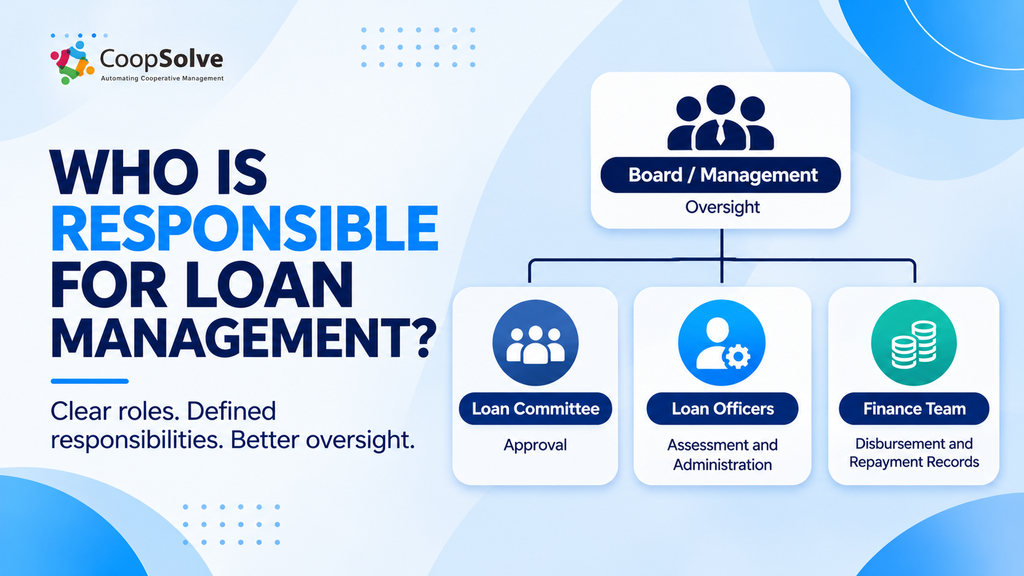
Loan administration becomes difficult when responsibility is assumed rather than assigned.
A cooperative may have a board, management team, loan committee, treasurer, accountant and administrative staff.
But having all of those roles does not automatically create a controlled process.
Each stage should have a clear owner and a clear control.
| Loan stage | Typical responsibility | Key control |
| Application | Member and designated loan staff | Complete application |
| Eligibility | Loan or administrative staff | Eligibility verification |
| Assessment | Loan officer or credit team | Documented appraisal |
| Approval | Authorized officer or committee | Delegated authority |
| Documentation | Administration or finance | Complete loan record |
| Disbursement | Authorized finance staff | Conditions confirmed |
| Repayment | Member and finance team | Accurate transaction posting |
| Monitoring | Loan staff and management | Arrears and portfolio review |
| Recovery | Management or authorized committee | Documented recovery procedure |
| Reporting | Management and board | Reliable management information |
The exact allocation should reflect the cooperative’s structure.
The important principle is that responsibility and control should be deliberate rather than accidental.
Where practical, duties should also be appropriately separated.
The person responsible for entering a transaction should not necessarily have unrestricted authority to approve, alter and reconcile the same transaction without oversight.
That is a governance consideration, not simply a software feature.
Common Cooperative Loan Administration Weaknesses and Their Controls
Many lending problems do not begin with a fundamentally bad loan policy.
They begin with gaps between the policy and what happens operationally.
| Common weakness | What can go wrong | Stronger control |
| Incomplete applications | Decisions are made using missing information | Application completeness checks |
| Inconsistent assessment | Similar members receive different treatment without a documented reason | Defined appraisal criteria |
| Unclear approval authority | The cooperative cannot establish whether a loan was properly authorized | Delegated approval limits |
| Poor documentation | Agreed terms become difficult to verify later | Complete centralized loan records |
| Delayed payment posting | Member balances and reports become inaccurate | Timely transaction recording |
| Untracked arrears | Repayment problems are identified too late | Regular exception and arrears monitoring |
| Unclear guarantor records | The cooperative cannot easily connect guarantees to loans | Linked borrower, loan and guarantor records |
| Multiple spreadsheet versions | Staff work from conflicting financial information | A controlled source of truth |
| Weak portfolio reporting | Management sees individual transactions but not broader risk patterns | Regular portfolio reporting |
This is why effective loan administration is not simply about having more forms.
It is about creating a reliable chain between:
Decision → Transaction → Record → Oversight
Can Cooperatives Use Excel to Manage Loans?
Yes.
Excel can be useful for a cooperative with relatively simple operations, particularly when the number of members, loans and users is manageable and the organization has disciplined record-keeping practices.
The problem begins when the spreadsheet becomes the system holding together a process that has outgrown it.
As membership and transaction volume increase, a cooperative may end up maintaining separate files for member information, contributions, loan balances, repayments and reports.
Multiple officers may update different versions of the same workbook.
Manual formulas and reconciliation then become increasingly important to everyday administration.
We have explored this problem in our guide to six signs a cooperative has outgrown Excel, including fragmented information, increasing administrative workload, difficult reporting and the growing challenge of maintaining consistent records as cooperative operations expand.
The better question is therefore not:
“Is Excel bad for cooperative management?”
It is:
“Can our current record-keeping system reliably support the cooperative’s current level of complexity?”
If the answer is increasingly no, dedicated cooperative management software becomes worth evaluating.
When Should a Cooperative Move From Excel to Loan Management Software?
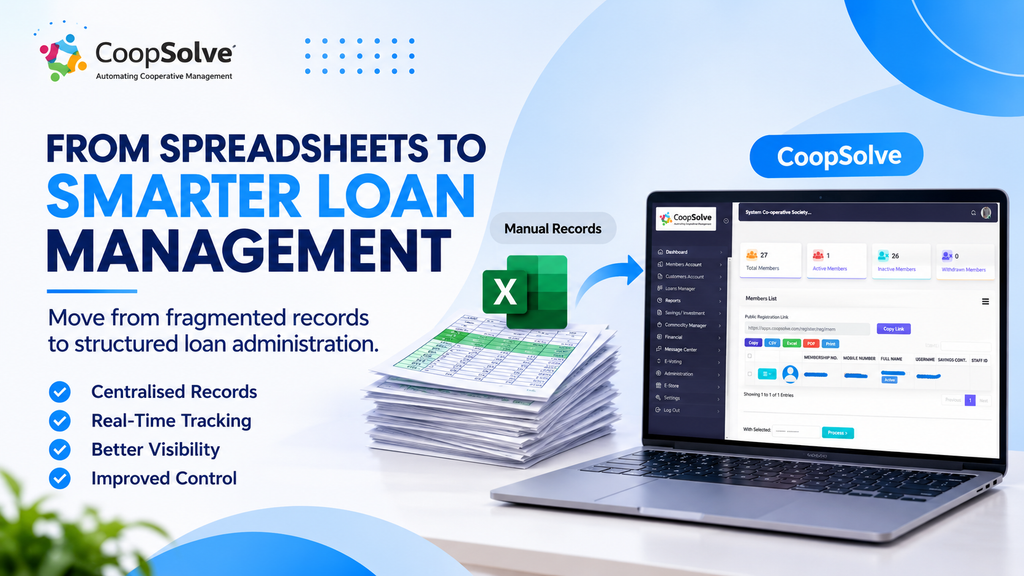
There is no universal membership number at which a cooperative must abandon spreadsheets. The decision should be based on operational complexity rather than an arbitrary threshold.
A cooperative may be approaching the point where dedicated software is useful when staff regularly reconcile conflicting records, spend significant time preparing reports manually, struggle to track overdue loans, cannot easily establish the current status of individual accounts, or need several people to work with the same financial information without creating version-control problems.
This is also where the distinction between a spreadsheet and a management system becomes important. A spreadsheet is primarily a flexible tool for storing and manipulating information.
A cooperative management platform is designed around recurring organizational processes, users, records, permissions and workflows.
We have also examined this transition in Why Cooperatives Are Moving From Excel to Cooperative Management Software, including the operational challenges that can emerge when growing cooperatives continue relying on fragmented spreadsheets and manual processes.
The goal should not be to replace Excel simply because software sounds more advanced. The goal is to use an operating system that provides the controls, visibility and record structure the cooperative actually needs.
Policy, People and Technology: The Three Layers of Loan Administration
The strongest loan-management processes do not depend on technology alone. They depend on three connected layers:
Policy defines what should happen. People apply the policy and exercise judgment. Technology helps record, organize, monitor and report what is happening.
This distinction is important because technology cannot compensate for an undefined lending policy. A cooperative cannot solve an unclear approval structure simply by installing software.
It cannot automate away poor judgment. It cannot create accountability where responsibilities have never been assigned. But the reverse is also true.
A cooperative can have a well-designed loan policy and capable staff and still struggle if its information is fragmented across paper files and spreadsheets. That is where technology becomes infrastructure.
The ILO’s Manage.COOP programme was developed to support established cooperatives with management and sustainability. Its training framework covers areas including governance and leadership, communication, conflict management, business and market growth, financial management and human resource management. The programme’s broader focus reinforces an important principle: technology should strengthen management capability, not substitute for it.
Effective digital transformation therefore starts with a process question: What should the cooperative’s loan process look like?
Only then should it ask: What technology will help us administer that process reliably?
How CoopSolve Helps Cooperatives Manage the Loan Lifecycle
This is where the principles above become practical. At CoopSolve, we built the platform around a simple operational problem: cooperative teams should not have to depend on disconnected spreadsheets, paper records and repetitive manual work to understand what is happening across their operations.
Loan administration creates information at every stage. A cooperative has the application, eligibility information, approval details, guarantor records, the loan itself, repayment activity, missed payments and the management information needed to understand the portfolio.
CoopSolve brings these loan-management activities into a structured digital environment.
With CoopSolve’s loan-management capabilities, cooperatives can start loan transactions, capture eligibility information, collect guarantor data, generate loan records and summaries, view and edit saved loan records, and track missed payments. The platform also supports the migration of historical loan records from paper or previous systems.
That means CoopSolve supports several stages of the loan lifecycle rather than treating loan administration as a single transaction. A cooperative does not simply need to know that a member received a loan.
It needs to know the status of that loan. It needs to maintain the associated record. It needs to capture repayment activity. It needs to identify missed payments. And it needs to make relevant information available to the people responsible for managing the cooperative.
That is the role CoopSolve is designed to play.
From Loan Records to Cooperative Management Infrastructure
The value of a digital system becomes clearer when loan administration is considered alongside the rest of the cooperative’s operations.
Loans do not exist in isolation. They are connected to members, savings, contributions, financial records and reporting. That is why CoopSolve is designed as a broader cooperative management system, rather than simply a digital loan register.
The platform supports cooperative membership records, savings and deposits, loans and loan history, financial records and other operational information within the same environment.
This gives cooperative teams a more connected way to manage the information that supports everyday administration. The objective is not to replace cooperative judgment. It is to give the people responsible for the cooperative better infrastructure for applying that judgment.
That distinction matters: Policy defines the process. People make decisions.
CoopSolve helps organize and operationalize the information created by those decisions.
What Should a Cooperative Be Able to See at Any Point in the Loan Lifecycle?
A useful test of loan administration is visibility. For any individual loan, management should be able to move from the original application to the current position without reconstructing the account manually from unrelated records.
At a minimum, the record should allow the cooperative to establish the member involved, amount approved, amount disbursed, applicable terms, approval information, payments received, outstanding balance and current repayment status.
For the wider portfolio, management should be able to move from individual accounts to a broader view of outstanding lending, repayments, overdue accounts and other relevant portfolio information.
This is the point where record-keeping becomes management infrastructure.
The purpose is not simply to have more data. It is to reduce the distance between what happened in the cooperative and what management can reliably see. A strong loan-management system should therefore help answer questions such as:
| Question | Why it matters |
| Who is the borrower? | Establishes the member connected to the loan |
| What was approved? | Establishes the original lending decision |
| What was disbursed? | Confirms the actual transaction |
| What has been repaid? | Shows repayment activity |
| What remains outstanding? | Shows the current obligation |
| Is the loan current? | Indicates whether follow-up may be required |
| Are payments being missed? | Helps identify accounts requiring attention |
| What does the wider portfolio look like? | Gives management a broader view of lending activity |
This is what turns a loan register into a management system.
Conclusion: Good Loan Administration Is a Governance System, Not Just a Loan Register
A cooperative loan is not complete when the money is disbursed. It is complete when the cooperative has administered the loan through its full lifecycle, maintained reliable records, monitored repayment, responded appropriately to problems and closed the account according to its procedures.
That requires more than an application form.
It requires a defined lending policy, clear responsibilities, consistent assessment, controlled approval, proper documentation, reliable repayment tracking, appropriate guarantor management and useful portfolio reporting.
For a smaller cooperative, spreadsheets and manual records may be sufficient for a period of time.
But as membership, lending activity and transaction volume increase, the record-keeping system becomes part of the cooperative’s financial control environment.
The objective of technology should not be to replace cooperative judgment.It should be to give the people responsible for the cooperative better infrastructure for applying that judgment.
A cooperative with reliable loan administration should be able to answer, without reconstructing its records from multiple disconnected sources:
Who borrowed? How much was approved? What was disbursed? Who authorized it? What has been repaid? What remains outstanding? Is the loan performing as expected? What needs attention?
Those questions are simple. Building a system that can answer them consistently is the real work of cooperative loan management.
At CoopSolve, we believe cooperative technology should make that work more structured, visible and manageable.
If your cooperative has reached the point where loan records, repayments, guarantor information and member records are spread across multiple spreadsheets and manual processes, CoopSolve can help bring those workflows into one structured cooperative management system.
Explore CoopSolve’s loan-management capabilities to see how CoopSolve supports loan transactions, eligibility information, guarantor data, loan records, historical loan records and missed-payment tracking as part of a broader cooperative management system.
Good loan management is not simply about giving members access to credit. It is about administering that credit responsibly, transparently and consistently from the first application to the final repayment.
Ready to Digitize Your Cooperative?
CoopSolve helps cooperative societies automate member management, contributions, loans, reporting and compliance from a single platform.
Book a Demo

