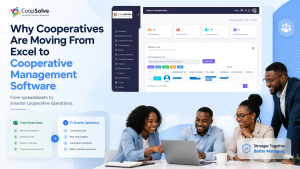


A cooperative can start with a simple spreadsheet, a few paper files and a small group of members. At that stage, the secretary may know most members personally, the treasurer can trace transactions without much effort, and the board can review the cooperative’s finances without waiting weeks for a report.
Growth changes that equation.
More members create more records. More savings and loan transactions create more entries to reconcile. More administrators create more opportunities for inconsistent information. Members begin asking for statements, repayment balances and contribution histories, while the board needs reliable financial information to make decisions.
Eventually, the problem stops being the amount of work itself. The real problem becomes how the cooperative manages that work.
A cooperative can have hardworking administrators and still struggle with inaccurate records, delayed reporting, weak communication, missed repayments and poor visibility into its finances.
That is why cooperative management should not depend entirely on individual memory, spreadsheets or manual processes. A strong operating system gives administrators a consistent way to capture information, manage transactions, monitor activity and produce reliable records.
The Singapore Ministry of Culture, Community and Youth’s governance guidance for credit cooperatives illustrates this principle from a governance perspective. Its guidance covers areas such as internal controls and loan management because sound processes help cooperatives protect members’ interests and strengthen accountability.
So what are the operational problems that cooperative administrators encounter most often?
Here are ten of the most important.
1. Poor Record-Keeping and Scattered Member Data
Ask an administrator for a member’s complete financial history and the answer should not depend on which computer contains the latest spreadsheet.
Yet many cooperatives still work across paper files, Excel workbooks, payment records, receipts and documents stored in different locations. One officer may have the latest contribution record while another has the most recent loan information.
That creates a simple but serious operational problem: the cooperative loses its single source of truth.
When records become difficult to reconcile, administrators spend more time checking information and less time managing the cooperative. Members may also question balances when different records produce different figures.
The issue extends beyond convenience. Accurate records support financial reporting, accountability and informed decision-making. The Singapore Ministry of Culture, Community and Youth’s Governance Guide on Internal Controls describes reliable financial and managerial reporting as one of the purposes of sound internal controls.
For a growing cooperative, the practical answer is to centralize member and transaction information rather than repeatedly reconstruct it from separate files.
CoopSolve addresses this problem through a centralized cooperative database that allows administrators to manage member information, financial transactions and historical records within one system. Its current platform also supports migration of existing records from paper or Excel-based systems.
The goal is not simply to replace paper with software. It is to make the cooperative’s information easier to find, update and use.
2. Lack of Financial Transparency
Members entrust cooperatives with money, so financial transparency is not an optional extra.
A member who cannot easily understand their savings balance, loan position or transaction history may begin to question the cooperative’s records. Even when the numbers are correct, poor visibility can create unnecessary suspicion.
The same problem affects leadership.
Board members and administrators need accurate information about the cooperative’s financial position before they can make responsible decisions. If producing that information requires manually combining several spreadsheets, transparency becomes slower and more difficult.
Cooperative governance guidance recognizes this relationship between information, controls and member confidence. The official governance guidance for Singapore credit cooperatives notes that good governance helps safeguard members’ deposits and maintain their confidence and trust.
A digital system can improve the visibility behind that transparency.
CoopSolve provides access to financial records such as member statements, balances and other cooperative financial information. Its platform also supports financial reporting and transaction records.
That gives administrators a better foundation for answering the questions members inevitably ask:-
- – What have I contributed?
- – What do I still owe?
- – What has happened to my account?
- – What does the cooperative’s financial position look like?
Transparency works best when the underlying records are organized enough to support it.
3. Inefficient Savings and Contribution Tracking
Savings management can look simple until a cooperative has hundreds or thousands of transactions to record.
Members may contribute weekly, monthly or according to a cooperative’s own schedule. Some may make additional deposits. Others may withdraw funds, contribute to special savings plans or change their contribution arrangements.
Manual systems make each additional transaction another opportunity for an entry error, delayed update or reconciliation problem.
The bigger issue is that savings information connects directly to other parts of cooperative administration. A member’s contribution history can affect their financial statement, eligibility for certain services and the cooperative’s overall financial reporting.
CoopSolve’s savings tools allow administrators to record deposits and withdrawals, manage agreed savings amounts and track shared capital. The platform also provides members with access to financial information and statements.
For cooperatives, that means savings management becomes part of a connected operating system rather than another spreadsheet that administrators have to maintain separately.
4. Loan Management and Repayment Tracking
Loan administration creates one of the most demanding operational workloads for many credit and multipurpose cooperatives.
The work does not end when the cooperative approves a loan.
Administrators must keep track of the borrower’s records, repayment schedule, outstanding balance, missed payments and other relevant information. As the number of borrowers increases, manual tracking becomes increasingly difficult.
That is why loan management requires more than recording disbursements.
It requires a process that allows the cooperative to monitor what happens after the loan leaves the cooperative’s account.
Official cooperative governance guidance reflects this broader view. The Ministry of Culture, Community and Youth’s Governance Guide on Loan Management provides guidance for credit cooperatives on developing or revising their loan-management procedures.
CoopSolve’s loan-management system supports loan applications and records, historical loan migration and the tracking of missed payments. Administrators can also view loan records and their current status.
The practical benefit is straightforward: administrators spend less time reconstructing a borrower’s history and gain a more structured way to monitor the loan lifecycle.
That does not eliminate credit risk. No software can guarantee repayment.
It does, however, give the cooperative better information and a more organized process for managing its loan portfolio.
5. Poor Communication With Members
A cooperative can maintain accurate records and still provide a poor member experience if communication breaks down.
Members need information about payments, account activity, meetings, loan obligations, savings and other cooperative activities. When administrators handle these updates manually, communication can become inconsistent.
One member may receive an update immediately. Another may hear about it days later. Someone else may have to call the office simply to confirm information that the cooperative already has.
That creates unnecessary administrative work and weakens member engagement.
Digital communication does not mean sending more messages. It means making important information easier to deliver at the right time.
CoopSolve’s platform includes member notifications and communication tools alongside financial and membership functions. Its current product information also describes SMS and email capabilities for member communication.
This can help cooperatives connect operational events with member communication instead of treating communication as a completely separate task.
6. Difficulty Generating Reliable Reports
Reporting often exposes weaknesses that administrators can hide during everyday operations.
A cooperative may record transactions throughout the month, yet struggle to answer basic management questions when the board requests a report.
- – How much has the cooperative collected?
- – How much remains outstanding?
- – How are members’ savings changing?
- – What does the current financial position look like?
- – Which records require attention?
If administrators must manually consolidate several files before answering those questions, reporting becomes a major administrative exercise.
Reliable reporting also matters for governance. The official Singapore guidance on internal controls for credit cooperatives identifies reliable financial and managerial reporting as a core objective of internal controls.
CoopSolve includes financial and operational reporting capabilities that allow administrators to retrieve records and generate reports from the system.
The real value is not the report itself.
It is the ability to move from “We need to calculate this” to “We already have the information.”
7. Weak Governance, Controls and Compliance Processes
Good governance becomes difficult when the cooperative cannot reliably show who did what, where information came from or how important transactions were handled.
This becomes particularly important as a cooperative grows.
The organization may have more officers, larger financial transactions, more members and greater regulatory responsibilities. At that point, informal processes that worked when the cooperative was smaller may no longer provide enough control.
Governance does not mean adding paperwork for its own sake.
It means creating processes that help the cooperative protect member interests, maintain accountability and make decisions using reliable information.
The Singapore Ministry of Culture, Community and Youth’s Code of Governance and related cooperative governance resources cover areas such as accountability, board matters, conflict of interest and governance evaluation.
Digital systems can support those processes by organizing records, controlling access to information and making operational information easier to retrieve.
CoopSolve includes user access management alongside its financial, membership and reporting functions.
However, software should support governance rather than replace it.
A cooperative still needs clear policies, responsible officers, appropriate approvals and effective oversight. Technology simply gives those processes a stronger operational foundation.
8. Slow and Disorganized Member Onboarding
Member growth should be good news.
But every new member creates work.
Someone must capture personal information, establish the member’s account, record the relevant contribution structure and maintain accurate records for future transactions.
When onboarding relies on paper forms or disconnected spreadsheets, the process can become slow and inconsistent.
The problem does not end after registration. Administrators must continue updating member information as people change addresses, contact details, financial arrangements or membership status.
A structured member database gives the cooperative a more reliable foundation.
CoopSolve allows cooperatives to register new members, update existing information and manage members’ financial transactions within its platform.
That makes onboarding part of the cooperative’s wider information system instead of an isolated administrative exercise.
For members, the result can be a smoother experience. For administrators, it means less duplication and fewer places to maintain the same information.
9. Too Much Time Spent on Routine Administrative Work
Not every operational problem involves a major financial risk.
Some simply consume too much staff time.
An administrator may spend part of the day searching for a member’s record, checking a contribution, calculating a balance, updating a spreadsheet, preparing a statement and then repeating the same process for another member.
Individually, each task seems small.
Collectively, they can consume hours that the cooperative could use for more valuable work.
Automation helps when it removes repetitive work without removing necessary oversight.
CoopSolve automates or structures several routine activities across savings, loans, payments, membership records and reporting. Its platform can also migrate existing transaction data into the system, reducing the need to rebuild historical records manually.
The objective should not be to automate everything.
The better objective is to automate repetitive administration so people can spend more time on work that requires judgment, member relationships and leadership.
10. Limited Visibility for Better Decision-Making
A cooperative cannot manage what its leadership cannot see.
If management receives financial information only after someone manually compiles it, decisions may come too late.
The board may need to understand loan performance. The treasurer may need to review contributions. Administrators may need to identify missed payments. Management may need to understand membership activity.
Without reliable information, these decisions can become dependent on assumptions.
That is where operational data becomes valuable.
A cooperative’s records should do more than prove what happened in the past. They should help leadership understand what is happening now and where attention may be needed next.
CoopSolve’s reporting and financial management tools bring information from cooperative activities into a structured system. The platform provides access to financial records, member information, savings activity, loan records and other operational data.
This does not turn software into a decision-maker.
Instead, it gives cooperative leaders better information from which to make their decisions.
And that distinction matters.
Good technology does not replace cooperative leadership. It gives leadership better visibility.
The Bigger Problem: Disconnected Operations
These ten challenges may look separate, but they often come from the same underlying problem.
A cooperative’s operations become fragmented.
Member information sits in one place. Loan records sit somewhere else. Savings transactions live in another spreadsheet. Reports require manual calculations. Communication happens through separate channels.
Each process may work individually.
The problem appears when they need to work together.
Consider a member who applies for a loan. The cooperative needs to know the member’s identity, contribution history, savings position, existing loans, repayment history and other relevant information. After approval, the cooperative must record the loan and continue monitoring repayments.
That is not ten separate administrative problems.
It is one connected workflow.
A cooperative management system therefore creates value when it connects these activities rather than simply digitizing each task separately.
That is the direction CoopSolve takes.
Its platform combines functions such as membership management, savings, loans, payments, financial records, reporting and accounting within a cooperative-focused system.
What Should Cooperatives Look for in Management Software?
Choosing software should not begin with the question, “How many features does it have?”
A better question is:
“Which operational problems will this system help us manage better?”
For a cooperative considering digital management software, the important evaluation areas include data management, financial transactions, loan administration, savings tracking, member management, reporting, user access and payment processes.
The system should also fit the cooperative’s actual workflow.
A credit cooperative may place greater emphasis on loans, repayments and risk management. A housing cooperative may need stronger savings and project-related tracking. A multipurpose cooperative may require broader financial, membership and sales capabilities.
The technology should adapt to the cooperative’s operating model rather than forcing every organization into the same process.
Where CoopSolve Fits
CoopSolve was built around the operational problems that arise when cooperatives manage growing amounts of financial and member information manually.
The platform provides tools for loan management, savings management, membership administration, accounting, payments, financial records, reporting and related cooperative operations.
Its current features also support migration from existing paper or Excel records, missed-payment tracking, member self-service and access to financial statements and balances.
That makes the platform relevant to a cooperative that has reached the point where spreadsheets and manual processes are creating more administrative work than the team can comfortably manage.
CoopSolve should not replace the cooperative’s policies, board oversight or financial controls.
Instead, it can provide the digital infrastructure through which those processes operate.
For cooperatives that are beginning to outgrow spreadsheets, the transition does not have to mean abandoning historical information. CoopSolve’s platform supports migration of existing records, making digital adoption a process rather than a complete restart.
Conclusion: Better Cooperative Management Starts With Better Operations
Most cooperative management problems do not begin with a lack of commitment.
They begin when the cooperative’s systems can no longer keep up with its activities.
More members create more data. More transactions create more records. More loans create more repayment information. More officers create more coordination requirements.
Without a structured system, that growth can create operational bottlenecks.
The solution is not technology for technology’s sake. A cooperative needs processes that make its records easier to manage, its finances easier to understand, its members easier to serve and its leadership better informed.
That is where cooperative management software can make a practical difference.
CoopSolve brings core activities such as member management, savings, loans, payments, financial records and reporting into a connected digital environment.
The bigger goal, however, is not simply to help administrators do paperwork faster.
It is to give cooperatives a stronger operational foundation for accuracy, transparency, accountability and sustainable growth.
When the system behind the cooperative becomes more organized, leadership can spend less time chasing records and more time leading the organization.
Frequently Asked Questions
What are the biggest operational challenges in cooperative management?
Common challenges include poor record-keeping, financial transparency issues, inefficient savings tracking, loan administration difficulties, weak member communication, slow reporting, governance and compliance challenges, disorganized onboarding, repetitive administrative work and limited management visibility.
Why do cooperatives struggle with manual record-keeping?
Manual systems become harder to manage as membership and transaction volumes increase. Paper files and disconnected spreadsheets can create duplicate records, delayed updates and reconciliation problems, making it harder for administrators to retrieve reliable information quickly.
How can cooperative management software improve operations?
Cooperative management software can centralize member and financial information, structure loan and savings processes, automate repetitive tasks, support reporting and give administrators faster access to operational records. The exact benefits depend on the software’s capabilities and how the cooperative implements it.
Can CoopSolve handle existing cooperative records?
Yes. CoopSolve’s current platform supports migration of historical loan and transaction records from paper and Excel-based systems into the platform.
Does cooperative software replace the need for good governance?
No. Software supports governance; it does not replace policies, oversight, approvals or responsible leadership. Strong governance still depends on appropriate controls, competent officers and accountability.
Is CoopSolve only for credit cooperatives?
No. CoopSolve’s current website lists credit cooperatives, agricultural and farmers’ cooperatives, housing cooperatives, multipurpose cooperatives and other organizations among its users.
When should a cooperative consider management software?
A cooperative should consider dedicated software when its existing processes make it difficult to keep records accurate, produce reports, track loans and savings, manage members or coordinate administrative work efficiently. Growth is often the point at which spreadsheets and manual processes begin to create significant operational friction.
Ready to Digitize Your Cooperative?
CoopSolve helps cooperative societies automate member management, contributions, loans, reporting and compliance from a single platform.
Book a Demo