

Learning how to start a cooperative society in Nigeria begins with understanding that the registration process is not exactly the same in every state.
Starting a cooperative society in Nigeria can be a practical way for people with a shared economic interest to pool resources, save collectively, access credit, invest together, and build an organisation they control democratically.
But there is an important detail that many online guides get wrong.
There is no single nationwide checklist that every cooperative in Nigeria can follow.
The registration process, minimum membership requirement, fees, documentation, training requirements and administrative procedures can differ by state and by the type of cooperative being formed. For example, Lagos State currently requires at least 20 foundation members, while published registration guidance from Ebonyi State and Kano State provides for a minimum of 10 members for a primary cooperative.
That means a guide telling every Nigerian founder that they need exactly 10, 20 or 50 people is potentially misleading.
The safer approach is to understand the general formation process, then confirm the specific requirements with the relevant cooperative authority in the state where the society will be registered.
This guide explains how to start a cooperative society in Nigeria in 2026, including how to choose the right cooperative model, determine your founding members, prepare your documents and bye-laws, understand registration costs, distinguish cooperative registration from CAC registration, and build the financial and record-keeping systems you will need after registration.
It also explains an important development that new and existing cooperatives should understand in 2026: Nigeria is moving toward a national digital cooperative identity and registry system involving the National Cooperative Smart Registry (NCSR), Cooperative Verification Number (CVN), and Cooperative Member Identification Number (CoopID).
How Do You Start a Cooperative Society in Nigeria?
To start a cooperative society in Nigeria, you generally need to establish a common economic purpose, meet the membership requirements applicable in your state, prepare the required documents and bye-laws, hold an inaugural meeting, and register with the appropriate cooperative authority.
The exact requirements depend on the state.
For example, the Lagos State Department of Cooperatives currently publishes requirements that include at least 20 foundation members, a common bond, a verifiable secretariat and members who are at least 18 years old. Lagos also requires the President, Secretary and Treasurer to attend an induction course and says newly registered societies must maintain statutory records and submit annual accounts and returns.
Ebonyi State’s published cooperative registration procedure, by contrast, states that primary cooperatives must have at least 10 members and specifies requirements around the proposed name, address, area of operation, objectives, shares and the resolution from the first meeting.
Kano State’s published cooperative registration guidelines also provide for at least 10 members and currently list a ₦15,000 non-refundable registration fee. That fee should be treated as a Kano-specific published fee, not a nationwide Nigerian cooperative registration fee.
The most important rule is therefore simple:
Before collecting money or filing documents, confirm the current registration requirements with the cooperative authority in your state.
What Is a Cooperative Society?
The International Cooperative Alliance (ICA) defines a cooperative as an autonomous association of people who voluntarily come together to meet common economic, social and cultural needs through a jointly owned and democratically controlled enterprise.
That definition is important because a cooperative is not simply a group of people contributing money to a common account.
A properly structured cooperative is a member-owned organisation. Its members participate in its economic activities, elect its leadership and collectively determine how the organisation operates.
One of the defining characteristics of a primary cooperative is democratic control. The ICA describes this through the principle of one member, one vote, meaning voting power is not simply determined by how much money a member has contributed.
In practical Nigerian terms, a cooperative might be formed by employees of a company who want to save and provide loans to one another, farmers who want to purchase inputs collectively, traders who want to access shared financing, residents who want to invest together, or professionals who want to create a structured savings and credit organisation.
The important question is not simply, “How do we register?” It is: What economic problem will this cooperative solve for its members?
Why Do People Start Cooperative Societies in Nigeria?
People form cooperatives because collective economic action can sometimes achieve what individuals cannot achieve alone.
A group of employees, for example, may be able to accumulate a meaningful pool of savings by contributing smaller amounts every month. That pool can then support member loans, investments or other activities approved by the society.
Farmers may use a cooperative to purchase inputs in larger quantities, share equipment, improve access to markets or strengthen their negotiating position.
Consumers may establish cooperatives to purchase goods or services collectively. Community groups may use them to organise savings and credit activities around a shared economic objective.
The model works because members contribute to a common organization and participate in its governance. However, the same collective structure that creates opportunity also creates responsibility.
Once a cooperative begins managing member savings, loans, shares, repayments, guarantees and financial records, weak administration can quickly become a serious problem. That is why registration is only the beginning.
Step 1: Define the Cooperative’s Economic Purpose and Model
Before worrying about registration forms, decide what the cooperative is actually going to do. A cooperative that primarily wants to mobilize savings and provide loans to members will have different operational needs from an agricultural cooperative that purchases farm inputs, or a multipurpose society that intends to combine several activities.
The purpose should be specific enough to guide your objectives, bye-laws, financial structure and future decisions. For example, “help members financially” is too vague.
A clearer objective might be: “To promote regular savings among members and provide affordable credit facilities to eligible members for productive, personal and approved economic purposes.”
The more clearly the founding members understand the cooperative’s purpose, the easier it becomes to determine the appropriate structure.
Step 2: Determine the Type of Cooperative You Want to Form
The type of cooperative matters because the applicable requirements can depend on the nature of the society and the state in which it is being registered.
A thrift and credit cooperative is commonly built around member savings and credit facilities. An agricultural cooperative may focus on farm inputs, equipment, processing, storage, marketing or other shared agricultural activities.
A consumer cooperative may help members obtain goods or services collectively. A multipurpose cooperative may have a broader set of economic activities.
The important point is not to choose a label simply because it sounds attractive. Your cooperative’s stated objectives should reflect what the organization will genuinely do.
If your proposed society intends to mobilise savings and provide loans, for example, your governance rules should clearly address savings, loan eligibility, repayment, guarantors, defaults, approvals and financial controls.
Step 3: Decide Who the Founding Members Will Be
This is one of the areas where online guides often give misleading universal answers. Nigeria does not have one membership number that should automatically be applied to every cooperative formation situation.
The requirement can depend on the state and the type of cooperative. Here is a useful illustration from current published government guidance:
| State | Published minimum for a primary cooperative | Other published requirements |
| Lagos | 20 foundation members | Members 18+, common bond, verifiable secretariat |
| Ebonyi | 10 members | Members must meet age, residence, common-purpose and occupation requirements |
| Kano | 10 members | Officers include President/Chairman, Vice President/Chairman, Secretary and Treasurer |
The Lagos State Department of Cooperatives currently states that members must be at least 18 years old, be of good character and sound mind, have a common bond and provide a verifiable secretariat address.
The Ebonyi State Government’s published procedure says primary cooperatives must have at least 10 members and states that prospective members must meet requirements relating to age, residence, common purpose and occupation.
Kano State’s published guideline also specifies at least 10 members and requires the appointment of key officers. This is why your first registration task should be to identify the authority and rules applicable to your particular cooperative.
Do not collect 10 people simply because an online article says, “10 members are required.” And do not assume you need 20 or 50 people unless the applicable rules say so.
Step 4: Establish the Cooperative’s Common Bond
A cooperative normally exists around some shared economic interest or purpose.That common bond might arise from employment, occupation, location, professional affiliation, agricultural activity, trade or another legitimate shared interest.
The point is to demonstrate that the proposed members are not simply unrelated individuals who have created an informal investment pool and labelled it a cooperative. Your common bond should therefore be reflected consistently in your objectives, membership rules and proposed activities.
For example, an employee cooperative might serve employees of a particular organization or group. An agricultural cooperative might be composed of farmers operating within a defined area and engaged in related agricultural activities.
The exact requirements should be confirmed with the relevant state cooperative authority.
Step 5: Choose a Proposed Name
Your founding members should agree on a proposed name that clearly identifies the society. The name should reflect the purpose or membership base where appropriate and should be checked against the naming requirements of the relevant authority.
Do not build your entire identity around a name before confirming that the name can actually be registered. The inaugural meeting should document the proposed name and the members’ resolution concerning the formation of the society.
Step 6: Establish the Area of Operation and Secretariat
Your cooperative will need an identifiable place from which it operates. Lagos State, for example, specifically requires a verifiable secretariat address, as set out in the Department of Cooperatives’ published guidance.
Ebonyi’s published procedure also asks applicants to provide the proposed address and area of operation.
This is more than an administrative detail. A cooperative needs a place where members can interact with the organisation, records can be maintained and regulatory officers can establish that the society actually exists and operates as represented.
If you are forming a workplace cooperative, the office may be located within or around the organisation’s premises, subject to the applicable rules.
If you are forming a community or occupational cooperative, your secretariat should correspond with the area and structure approved by the relevant authority.
Step 7: Hold and Document the Inaugural Meeting
Once the founding members are assembled, hold a properly documented inaugural meeting. This meeting should not be treated as a casual gathering.
It establishes the foundation of the society. The members should discuss and resolve matters such as the proposed name, objectives, membership, area of operation, proposed officers, share structure, savings expectations and the intention to proceed with registration.
The minutes should accurately record what was discussed and resolved. Ebonyi’s current published registration procedure specifically requires a certified copy of the resolution passed at the first meeting of members.
Lagos also requires an inaugural meeting and minutes as part of its published registration process. This is one reason why good record-keeping should begin before the cooperative receives its certificate, not after.
Step 8: Draft and Adopt the Cooperative’s Bye-Laws
Your byelaws are one of the most important documents in the cooperative. They should not be treated as paperwork that exists only to satisfy a registration officer.
The bye-laws establish the rules under which members, officers and the cooperative itself will operate.
A well-designed set of bye-laws should address matters such as membership admission and withdrawal, member rights and responsibilities, meetings, elections, voting, officer responsibilities, financial management, savings, loans, guarantors, defaults, dispute resolution, use of funds, treatment of surplus and procedures for changing the bye-laws.
The specific format and approval requirements can vary by state, so founders should work with the relevant cooperative authority and use any official model or prescribed structure where required.
The International Cooperative Alliance’s cooperative principles provide a useful governance foundation. Its seven principles cover voluntary and open membership, democratic member control, member economic participation, autonomy and independence, education and training, cooperation among cooperatives, and concern for community.
Your bye-laws should therefore do more than describe how money moves. They should establish how the cooperative remains democratic, accountable and member-controlled.
Step 9: Decide the Cooperative’s Share Capital and Savings Structure
One of the most important financial decisions is distinguishing between different types of money members contribute. Share capital represents a member’s capital participation in the cooperative. Savings or thrift contributions represent recurring amounts a member deposits under the cooperative’s savings structure.
Fees may cover administrative or registration-related activities. Reserves and retained surplus may be maintained according to the applicable law, bye-laws and decisions of the cooperative. These categories should not simply be mixed together in one spreadsheet column.
Suppose 20 founding members agree to purchase shares worth ₦10,000 each. That creates ₦200,000 in share capital.
If those same members subsequently contribute ₦20,000 each every month as savings, that is a separate financial stream.
The distinction matters because the cooperative needs to know what money represents ownership capital, what belongs to a member as savings, what has been allocated to the cooperative’s reserves, and what has been used to finance loans or other approved activities.
Your financial structure should therefore be documented in the bye-laws and reflected accurately in the cooperative’s accounting records.
Do not insert a supposedly universal percentage for reserves, dividends or member withdrawals into your constitution simply because you saw it in an online article. The applicable law, regulations, approved bye-laws and the cooperative’s financial decisions should determine the treatment.
Step 10: Prepare the Documents Required by Your State
The exact registration documents will depend on the relevant authority. However, the types of information commonly requested include the cooperative’s proposed name, address, area of operation, objectives, details of members and officers, share information, minutes or resolutions from the inaugural meeting and other prescribed forms.
For example, the Ebonyi State Government’s current published procedure specifically lists the proposed name, address, area of operation, objectives, number and value of shares, certified first-meeting resolution and official seal among its requirements.
Lagos publishes a different process, including the formal application, inaugural meeting, applicable fees, induction, statutory record books and subsequent monitoring.
This illustrates an important principle: Use online guides to understand the process. Use your state’s current official requirements to prepare the actual application.
Step 11: Apply Through the Appropriate Cooperative Authority
For a state-based primary cooperative, the relevant registration process is handled through the cooperative authority in the state where the society is being registered.
In Lagos, for example, the Department of Cooperatives under the Ministry of Commerce, Cooperatives, Trade and Investment provides the published registration procedure.
This is where founders need to understand the difference between cooperative registration and CAC registration.
Is CAC Registration the Same as Cooperative Registration?
No. The Corporate Affairs Commission and the state cooperative authority perform different functions. The most common mistake is to assume that registering an association or organization with CAC automatically makes it a registered cooperative society.
It does not. If you are establishing a cooperative, you need to determine the cooperative registration route applicable to your society and state.
CAC may become relevant to a particular organisation depending on its legal structure or other activities, but it should not be presented as a substitute for the applicable cooperative registration process.
Therefore, if someone tells you: “Just register your cooperative with CAC and you are done.” Do not rely on that statement without checking the requirements of your state’s cooperative authority.
Step 12: Understand Cooperative Registration Cost
There is no responsible way to give one universal “cost of registering a cooperative in Nigeria” without knowing the state and the type of cooperative. Fees can include registration charges and other administrative costs, depending on the jurisdiction and process.
Kano State’s published cooperative registration guideline, for example, currently specifies a ₦15,000 non-refundable registration fee. That does not mean every cooperative in Nigeria pays ₦15,000.
Similarly, you should not assume that the cost of registering in Lagos is the same as the cost in Ebonyi, Kano, Ogun, Rivers, Enugu or any other state. Your total startup budget should also account for more than the registration fee.
Depending on your cooperative, you may need to budget for documentation, meetings, statutory books, an official seal, bank account setup, administrative expenses, training, accounting, member onboarding and eventually software or other management infrastructure.
The right question is therefore: “What are the current registration and startup requirements for my cooperative in my state?”
Step 13: Complete Inspection, Training and Other State Requirements
Some states include additional administrative stages after the initial application. Lagos, for example, currently requires the President, Secretary and Treasurer to attend an induction course at the Lagos State Cooperative College. It also requires the purchase of statutory record-keeping books and provides for monitoring and supervision before the Certificate of Registration and Bye-laws are issued, according to the Department of Cooperatives’ published guidance.
Other states may use different procedures. Do not assume that because another cooperative completed a particular process, your society will follow exactly the same timeline. The relevant cooperative authority should confirm what applies to your application.
Step 14: Receive Your Registration Documents and Set Up Properly
Once the applicable registration process has been completed and approved, the cooperative should retain its registration documents and approved bye-laws securely.
But this is where many guides stop. That is a mistake. Receiving a certificate is not the end of cooperative formation. It is the beginning of cooperative administration.
From this point forward, the society needs systems for managing its members, savings, loans, repayments, financial records, meetings, approvals, reports and regulatory obligations.
Important: Cooperative registration requirements, fees, membership thresholds and procedures can change. The examples in this guide are based on published guidance available at the time of writing. Before submitting an application, confirm the current requirements with the cooperative authority in your state.
What Should You Do After Registering a Cooperative Society?
The first year of a cooperative’s life can determine whether the organisation becomes a trusted financial institution for its members or becomes an administrative problem.
Lagos State’s published post-registration requirements include maintaining accurate and up-to-date books, submitting annual statements of accounts and returns, holding regular meetings and an AGM, participating in ongoing training and remaining compliant with the Cooperative Societies Law.
Those responsibilities point to a broader truth. A cooperative does not become trustworthy because it has a certificate. It becomes trustworthy because its members can see that their money, records and decisions are being managed properly.
Build a Reliable Member Record System
Your cooperative should maintain a complete record for every member. That record should connect the member’s identity and membership information with their financial activity.
As the society grows, you may need to track membership status, shares, savings, withdrawals, loans, repayments, guarantor relationships, communications and other transactions.
This becomes difficult when information is spread across paper forms, notebooks, individual Excel files and WhatsApp messages.
A member should not have to wait several days simply to discover what their current savings or outstanding loan balance is. And an executive committee should not have to search through several spreadsheets before preparing a financial report.
For cooperatives looking to strengthen this part of their operations, cooperative software can improve member registration and verification by bringing member information into a more structured digital environment.
Keep Savings, Loans and Repayments Reconciled
For a cooperative that provides loans, reconciliation becomes particularly important.
Imagine a member has:
- – ₦500,000 in savings
- – ₦200,000 in share capital
- – a ₦1 million outstanding loan
- – three repayments already made
- – one active guarantor obligation
If different parts of that information exist in different spreadsheets, notebooks and bank statements, determining the member’s true financial position becomes unnecessarily difficult.
Now multiply that by 100 members. Then 500. Then 5,000. The problem is no longer simply “record-keeping.” It becomes an internal control problem. A centralised system can make it easier to maintain a consistent record of member transactions and financial obligations as the cooperative grows.
Why Cooperatives Eventually Move Beyond Excel
Excel is useful. For a small cooperative just getting started, a carefully designed spreadsheet can be better than having no structured record at all. The problem begins when the cooperative starts treating a spreadsheet as a complete cooperative management system.
A cooperative may have member records in one workbook, savings in another, loan calculations in a third, bank transactions in another file and meeting records in physical folders.
Different executives may have different versions of the same file. A formula can be accidentally overwritten. A transaction can be entered twice. A member’s balance can be calculated differently by two people.
A report can take hours to prepare. And when an executive leaves, valuable institutional knowledge may leave with them. This is why growing cooperatives may eventually need to move from Excel to dedicated cooperative management software.
The issue is not that Excel is “bad.” The issue is that a cooperative eventually needs infrastructure designed around cooperative operations rather than a collection of generic spreadsheets.
What Should Cooperative Management Software Actually Do?
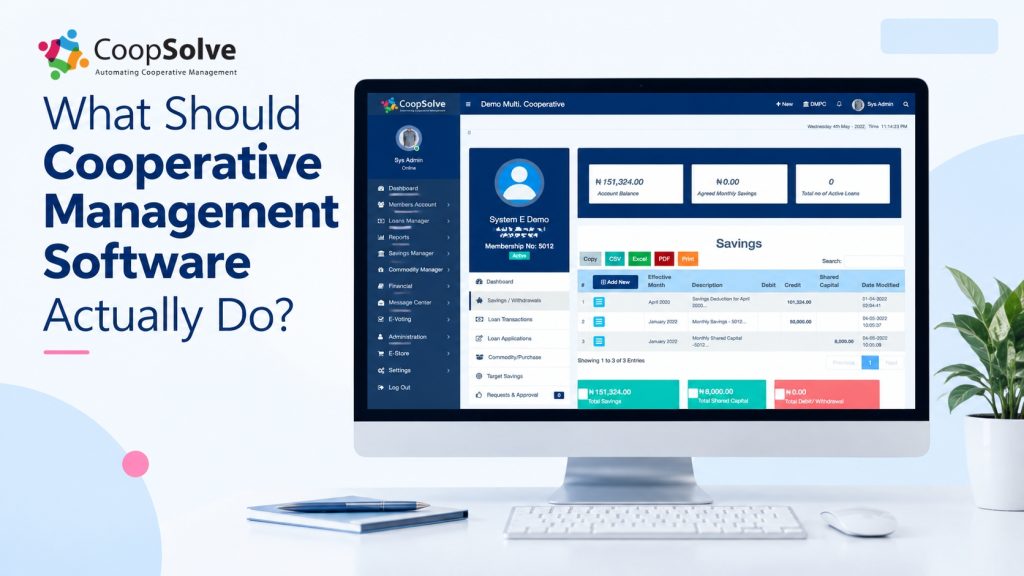
Good cooperative software should centralize the information the organization needs to operate. That includes member management, savings, loans, repayments, financial records, reporting and access controls.
It should also make it easier for the cooperative to maintain a reliable history of transactions and decisions. This is especially important when responsibility is shared among several executives.
A cooperative should not depend on one secretary’s laptop or one treasurer’s personal spreadsheet. The organization owns the records. The system should therefore support continuity beyond individual officers.
If your cooperative is evaluating digital systems, A Beginner’s Guide to Choosing the Right Cooperative Management Software can help you understand the features and considerations that matter before choosing a platform.
How CoopSolve Can Support a Growing Cooperative
This is where cooperative management software becomes relevant. CoopSolve is built specifically around cooperative and financial-management workflows, including member management, savings, loans, financial records and reporting. Its platform allows cooperatives to move member and transaction data from Excel or paper records into a centralised cloud environment.
Instead of maintaining separate spreadsheets for every process, a cooperative can manage members, savings and loan activity within one system.
CoopSolve also provides loan management capabilities, including loan records, guarantor information and loan status tracking, alongside savings management and financial reporting.
That matters because the goal of digitization should not simply be to make records look modern. The goal is to make the cooperative more accurate, transparent, accessible and easier to manage.
If your cooperative is still operating with paper records and disconnected spreadsheets, you can also explore how cooperative software can solve the problems created by manual records.
And if you are starting from scratch, it is worth thinking about your record-keeping infrastructure before your membership grows to the point where migrating years of transactions becomes difficult.
Nigeria’s Cooperative Sector Is Becoming More Digital in 2026
This is one of the most important developments cooperative executives should understand. On August 12, 2026, the Federal Government announced an agreement involving the Federal Ministry of Agriculture and Food Security, the Cooperative Federation of Nigeria and Seam fix to deploy a National Cooperative Identity, Trust and Digital Governance Infrastructure.
The announcement also introduced an immediate six-month National Revalidation and Re-certification Exercise for existing cooperatives. Under the announced process, existing cooperatives are expected to approach their respective State Departments of Cooperatives for verification and authentication of their registration records.
Following successful revalidation, cooperatives will be onboarded onto the National Cooperative Smart Registry (NCSR) and issued a Cooperative Verification Number (CVN). Members are expected to progressively receive a Cooperative Member Identification Number (CoopID).
The Federal Ministry of Information and National Orientation’s August 2026 announcement provides the government’s current information on the announced National Cooperative Identity infrastructure, revalidation exercise, NCSR, CVN and CoopID.
This development is important because it signals a wider shift in the cooperative sector. The future of cooperative administration is increasingly digital. That makes accurate records, reliable member data and proper governance more important, not less.
For an existing cooperative, this means record clean-up and verification should not be treated as an afterthought. For a new cooperative, it means there is a strong reason to build good data practices from the beginning.

The Seven Cooperative Principles Every Founder Should Understand
Registration tells you how to establish the organization. Cooperative principles help explain how the organization should behave. The International Cooperative Alliance (ICA) identifies seven internationally recognized cooperative principles.
1. Voluntary and Open Membership
Cooperatives are voluntary organisations open to people who can use their services and accept the responsibilities of membership.
2. Democratic Member Control
Members participate in setting policies and making decisions. In primary cooperatives, the principle is generally expressed as one member, one vote.
3. Member Economic Participation
Members contribute to and democratically control the cooperative’s capital. Surpluses can be directed toward developing the cooperative, building reserves and benefiting members according to the cooperative’s approved arrangements.
4. Autonomy and Independence
Cooperatives remain member-controlled organisations even when they enter agreements with governments, businesses or other organisations.
5. Education, Training and Information
Members, elected representatives, managers and employees need the knowledge required to contribute effectively to the cooperative.
6. Cooperation Among Cooperatives
Cooperatives become stronger when they work with other cooperatives through local, national, regional and international structures.
7. Concern for Community
Cooperatives work toward sustainable community development through policies approved by their members. These principles are not simply theoretical. They can influence how you design your membership rules, voting structure, training programme, financial policies and governance system.
Final Thoughts: Registration Is Only the Beginning
Starting a cooperative society in Nigeria is not simply a matter of gathering people, collecting money and submitting a form. It is the creation of a member-owned economic institution.
That means the founders need to think about three things at the same time. First, compliance. The cooperative must follow the registration and governance requirements applicable to its state and type.
Second, financial structure. Members need clear rules around shares, savings, loans, repayments, reserves and the use of cooperative funds.
Third, operational infrastructure. The society needs reliable systems for maintaining member information, recording transactions, producing reports and maintaining accountability as it grows.
The first two are obvious to most founders. The third is often ignored until it becomes a problem. That is why a cooperative should think about its record-keeping and management infrastructure from the beginning. A cooperative with 20 members can still make mistakes.
A cooperative with 2,000 members simply has more opportunities for those mistakes to become expensive.
In 2026, that operational discipline is becoming even more important as Nigeria moves toward stronger digital identification, verification and governance infrastructure for cooperatives.
If you are forming a new cooperative, start with the right legal and governance foundation.
If you already operate a cooperative, make sure your records, financial controls and member data can support the organisation you are trying to build.
And when spreadsheets, paper records and disconnected systems begin creating more administrative work than they solve, consider moving to a dedicated cooperative management platform.
CoopSolve helps cooperatives manage members, savings, loans, transactions and financial reporting from a centralised digital system, while also supporting migration from existing Excel or paper records.
Explore CoopSolve’s cooperative management platform
Ready to Digitize Your Cooperative?
CoopSolve helps cooperative societies automate member management, contributions, loans, reporting and compliance from a single platform.
Book a Demo