
For many cooperatives, Excel is where management starts.
It is familiar, flexible, and useful for simple calculations and record-keeping. A small cooperative with a limited number of members may be able to manage contributions, loan records, expenses, and reports with a few well-organized spreadsheets.
But as a cooperative grows, the same spreadsheets that once made management simple can become increasingly difficult to control.
More members mean more transactions. More transactions mean more records to update, reconcile, review, and report. Add multiple officers, loan approvals, financial reporting, member requests, and governance responsibilities, and Excel can quickly become a system that requires more manual effort than the cooperative can comfortably sustain.
This is where cooperative management software becomes valuable.
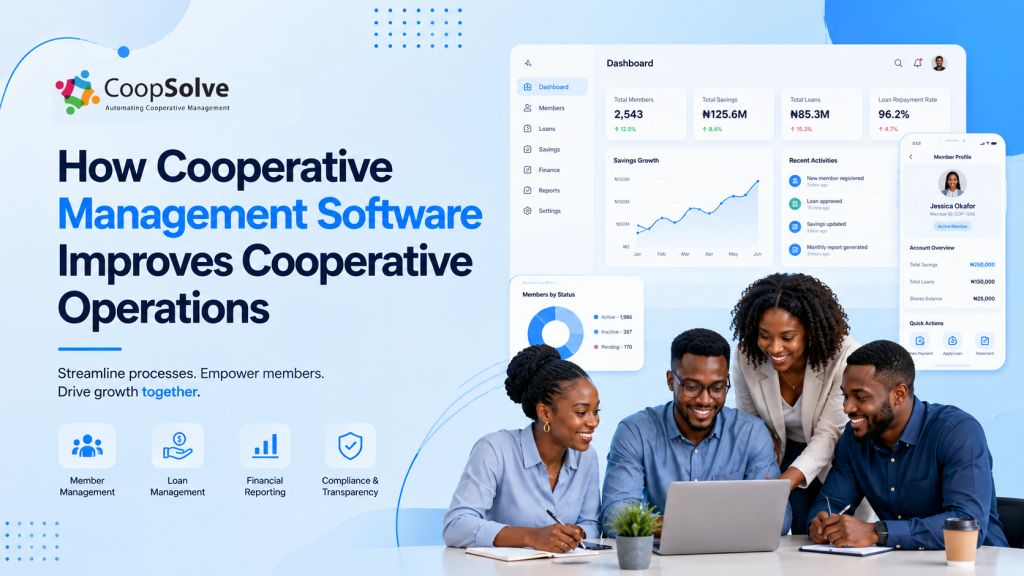
Dedicated cooperative management software is designed to bring member records, savings, loans, reporting, and administrative processes into a more structured system. Instead of relying on disconnected spreadsheets and manual processes, cooperatives can build a centralized system that supports greater accuracy, transparency, accountability, and growth.
The need for effective systems becomes even more important as cooperatives grow across Africa, including workplace cooperatives, thrift societies, agricultural cooperatives, and other member-owned organizations.
If you are new to the concept of cooperatives, our guide on what a cooperative society is and how it works provides a useful starting point.
So how do you know when your cooperative has outgrown Excel?
Here are six signs to look for.
1. Your Cooperative Has Multiple Versions of the Same Information
One of the clearest signs that a cooperative has outgrown Excel is fragmented information.
The savings officer may have one spreadsheet. The accountant may maintain another. The secretary may keep a separate member list, while the loan committee has its own records.
Eventually, simple questions become difficult to answer.
Which spreadsheet contains the most recent information? Who updated the member’s contribution? Why does the balance in one report differ from another? Which version should leadership use when preparing financial statements?
When information is spread across multiple files, maintaining consistency becomes increasingly difficult.
Cooperative management software provides a centralized environment where important information can be stored and managed in one place. Member records, savings contributions, loans, repayments, and reports can be connected instead of existing as isolated spreadsheets.
This creates a more reliable source of information for cooperative officers and leadership.
2. Financial Errors Are Becoming Harder to Detect
Spreadsheets can perform calculations, but they still depend heavily on how information is entered, formulas are created, and files are maintained.
Research by spreadsheet researcher Raymond Panko has found that spreadsheet errors are relatively common and can be difficult to detect. His research also highlights the risks of relying on spreadsheets for important financial and decision-making activities. Panko’s research on spreadsheet errors examines how errors can occur even in relatively simple spreadsheet tasks and why some errors remain difficult to identify.
In a separate review of spreadsheet research, Panko concluded that while individual spreadsheet errors may be uncommon at the cell level, larger spreadsheets can have a high likelihood of containing at least one incorrect result, while those errors can be difficult to detect and correct. Read Panko’s review of spreadsheet error research.
For a cooperative, this means that manual record-keeping can create opportunities for mistakes in areas such as contribution calculations, loan balances, repayment records, and financial reports.
The problem is not necessarily that someone made a careless mistake. Manual systems simply create more opportunities for mistakes to occur.
As transaction volumes increase, checking every calculation and record manually becomes less practical.
Dedicated cooperative management software can automate calculations and maintain transaction records within a structured system. This can reduce repetitive manual work and make it easier for administrators to maintain consistent records.
More importantly, it gives cooperative leaders greater confidence in the information they use to make financial and operational decisions.
3. Members Have Limited Visibility Into Their Information
Trust is one of the most important assets a cooperative has.
The International Cooperative Alliance (ICA) identifies democratic member control and member economic participation among the seven cooperative principles. The ICA also emphasizes accountability to members and the importance of transparency within democratic cooperative structures. See the International Cooperative Alliance’s Cooperative Identity, Values and Principles.
However, when member information is managed primarily through spreadsheets, access to that information often depends on individual officers.
A member may need to contact the secretary to confirm a contribution history. Another member may need to request a loan balance. Statements may only become available when an officer prepares them manually.
As membership increases, this creates unnecessary administrative pressure and can make members feel disconnected from their own financial information.
Cooperative management software can improve this experience by giving authorized users access to relevant records, including savings information, loan details, contribution history, and statements.
The result is greater visibility for members and less dependence on individual officers to answer routine questions.
Transparency should not only happen during an annual meeting or when a member makes a request. It should become part of the cooperative’s everyday operations.
4. Your Officers Spend Too Much Time on Repetitive Administration
Ask cooperative leaders what takes up their time, and the answer is rarely only strategic planning.
A significant amount of administrative work can go into updating member records, recording contributions, tracking loan repayments, preparing reports, reconciling transactions, generating statements, and compiling information for meetings.
When these processes are managed manually, even simple tasks can consume hours.
The International Labour Organization (ILO) has developed management resources such as Manage.COOP to support established cooperatives and improve management and sustainability. The programme covers areas including governance and leadership, communication, business growth, financial management, and human resource management. Read more about the ILO’s Manage.COOP programme.
Technology cannot replace good management, but it can reduce the amount of repetitive work required to maintain a management system. With cooperative management software, routine processes can be structured and automated. Information entered into the system can be used across relevant records and reports rather than requiring officers to repeatedly update different spreadsheets.
This gives cooperative leaders more time to focus on member engagement, governance, financial planning, growth, and long-term sustainability.
For a broader look at the problem of spreadsheet-based cooperative management, read why cooperatives are moving from Excel to cooperative management software.
5. You Cannot Easily Track Who Did What
As a cooperative grows, accountability becomes increasingly important. Leadership needs to know who approved a transaction, who updated a member record, when information was changed, and how important decisions were handled.
Excel files can be copied, renamed, edited, emailed, or stored in different locations. Unless the cooperative has a carefully designed process around them, it can become difficult to establish a complete history of changes.
This becomes particularly important when dealing with financial records.
Cooperative management software can provide features such as role-based permissions, approval workflows, activity tracking, digital documentation, and audit trails. These controls can help create a clearer record of how information moves through the organization.
This also supports the broader governance principles of cooperatives. The International Cooperative Alliance describes cooperatives as democratic organizations in which elected representatives are accountable to the membership. Learn more about the ICA’s cooperative principles.
Instead of relying entirely on people’s memory or searching through multiple files, a structured digital system can make accountability easier to maintain. Strong governance is not only about having rules. It is also about having systems that make those rules easier to follow.
6. Your Current System Is Struggling to Keep Up With Growth
A small cooperative may be able to manage its operations using spreadsheets without significant difficulty. The challenge comes when the cooperative begins to grow.
More members bring more contributions, more loans, more repayments, more requests, and more information. The number of transactions increases, reporting becomes more demanding, and officers have more responsibilities to manage.
At some point, adding another spreadsheet is no longer a solution.
Digital transformation can help organizations improve how they manage information and operations. The Food and Agriculture Organization of the United Nations (FAO) notes that digital transformation can help smallholders, cooperatives, and rural micro, small and medium enterprises increase productivity, improve bargaining power, diversify income, and access education and advisory services. Read the FAO’s work on digital transformation.
For cooperatives, digital transformation is not simply about replacing paper with computers. It is about creating systems that can support the organization as its operations become more complex.
Cooperative management software provides infrastructure for managing increasing volumes of information without depending entirely on manual processes.
The goal is not to abandon Excel because Excel is bad. The goal is to use a system that is designed for the kind of organization a cooperative has become.
Why This Matters for Nigerian Cooperatives
Nigeria has a wide range of cooperative societies, including workplace cooperatives, thrift and credit societies, agricultural cooperatives, and community-based savings organizations.
As these organizations grow, managing member contributions, loans, repayments, records, and reporting manually can become increasingly difficult.
The importance of strong cooperative management is also reflected in work by the International Labour Organization in Nigeria. In 2026, the ILO reported on cooperative development training in Nigeria that focused on areas including cooperative principles, governance, financial literacy, decision-making, transparency, and accountability. Read the ILO’s report on strengthening cooperative development in Nigeria.
For Nigerian cooperatives, adopting a dedicated management system can therefore be part of a broader effort to strengthen administration, improve access to information, and support sustainable growth.
The need for better systems is not unique to Nigeria. Cooperatives across Africa and other regions face similar challenges as membership, transactions, reporting responsibilities, and member expectations increase.
The important question is not whether every cooperative needs sophisticated technology immediately. It is whether the systems currently being used can support the cooperative’s present needs and future growth.

The Hidden Cost of Staying on Excel
One reason cooperatives continue using Excel is simple: they already have it. The software itself may appear inexpensive compared with investing in a dedicated management platform. But the real cost of a manual system is not always visible on an invoice.
It appears in the hours officers spend correcting records. It appears when reports take days to prepare. It appears when members dispute balances because information is inconsistent.
It appears when leadership makes decisions using outdated information. It appears when an officer has to search through several files to understand what happened to a transaction. And it appears when the cooperative reaches a point where its administrative processes can no longer keep pace with its growth.
The cost is therefore not only the spreadsheet itself. It is the operational time and risk created when a growing cooperative depends on a system that was not designed around its increasingly complex financial, administrative, and governance needs.
The question is no longer simply, “Can our cooperative survive with Excel?” The better question is, “How much time, efficiency, transparency, and control are we losing because our current system cannot support where we want to go?”
Why CoopSolve Exists
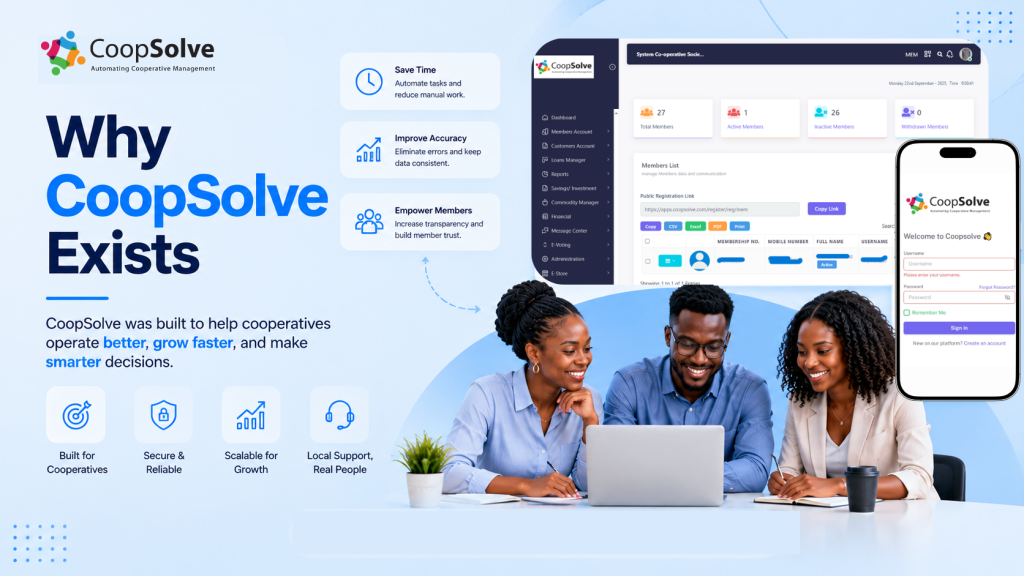
CoopSolve was built for cooperatives that are ready to move beyond scattered spreadsheets and manual administration.
The platform brings important cooperative operations into one structured environment, helping organizations manage members, savings, loans, reports, and administrative workflows more efficiently.
Instead of depending on multiple spreadsheets to understand what is happening across the cooperative, leaders can work from a centralized system designed around cooperative operations.
CoopSolve also supports connected member experiences across multiple communication channels, helping cooperatives manage information and engage with members as their organizations grow.
The goal is not simply to give cooperatives another piece of software. It is to give cooperative leaders a better way to manage the information, money, people, and processes they are responsible for.
Frequently Asked Questions
What is cooperative management software?
What is cooperative management software?
Cooperative management software is a digital platform designed to help cooperative societies manage members, savings, loans, transactions, reporting, and administrative processes in a centralized system.
When should a cooperative stop using Excel?
When should a cooperative stop using Excel?
There is no fixed membership number at which a cooperative must stop using Excel. However, frequent data inconsistencies, growing administrative workloads, difficult reporting, limited member visibility, and challenges tracking changes can indicate that a cooperative has outgrown its spreadsheet-based system.
Can cooperative management software manage savings and loans?
Can cooperative management software manage savings and loans?
Yes. A dedicated cooperative management platform can be designed to manage member savings, contributions, loans, repayments, balances, and related records within one system.
What should cooperatives look for in management software?
What should cooperatives look for in management software?
Cooperatives should consider whether the platform can support their current membership size, financial operations, reporting requirements, user permissions, governance processes, and future growth. Ease of use, data security, member access, and reliable support are also important considerations.
Is Your Cooperative Ready to Move Beyond Spreadsheets?
Excel can be a useful starting point. But if your cooperative is managing hundreds of members, processing increasing numbers of transactions, spending too much time preparing reports, dealing with inconsistent records, or struggling to maintain clear accountability, those may be signs that your current system has reached its limits.
The right cooperative management software can help your organization move from fragmented records to centralized management, from repetitive administration to more efficient workflows, and from limited visibility to greater transparency.
Growth should not make cooperative management harder. Your systems should grow with you.
If your cooperative is ready to move beyond spreadsheets, explore how CoopSolve can help you manage members, savings, loans, reporting, and operations in one place.
Ready to Digitize Your Cooperative?
CoopSolve helps cooperative societies automate member management, contributions, loans, reporting and compliance from a single platform.
Book a Demo